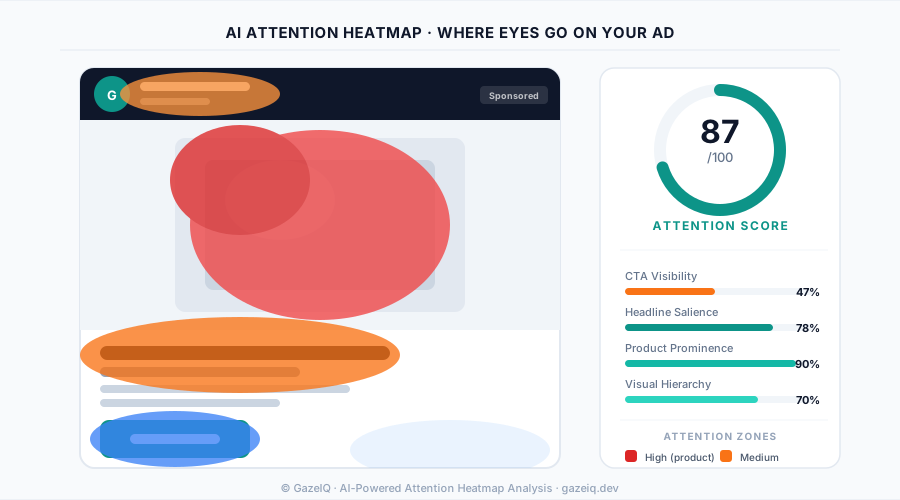
What Eye Tracking Actually Measures
Eye tracking records three things: fixations (where the eye stops and focuses), saccades (rapid jumps between fixation points), and dwell time (how long the eye stays on each element). Combined, these create a fixation sequence—the exact order in which a viewer processes the elements of your ad.
For ad creative, this data is commercially invaluable. It answers the question that click-through rates can't: did viewers even see your CTA before they scrolled past? A low CTR doesn't always mean the offer is bad. Often, viewers never registered the call to action at all—because it fell outside their natural fixation path.
How many distinct stops the eye makes on each element
How quickly each element attracts the first gaze landing
How long viewers spend looking at each element in aggregate
How AI Attention Prediction Works
Traditional eye tracking requires a lab, hardware, recruited participants, and weeks of analysis. AI attention prediction replicates the output—gaze patterns and fixation heatmaps—using a deep learning model trained on millions of lab eye-tracking recordings.
The model has learned the visual properties that reliably attract human attention: contrast gradients, color salience, face presence, text density, edge sharpness, and spatial position. When you upload a new creative, the model applies these learned patterns to generate a predicted gaze map in milliseconds.
Upload
Your ad creative is uploaded as an image (static) or first frame (video). The model accepts all standard ad formats and sizes.
Saliency computation
The model computes a saliency map—a pixel-level prediction of how much attention each part of the image is likely to attract—based on low-level visual features (contrast, color, orientation) and high-level features (faces, text, objects).
Fixation path simulation
A gaze simulation layer converts the saliency map into a realistic fixation sequence, modeling how the eye moves from one high-salience element to the next during a 2–3 second viewing window.
Element scoring
Key creative elements (CTA, headline, product, brand logo) are detected and scored against the predicted fixation path. Elements in the top decile of fixation probability receive high scores; elements outside the main gaze path receive low scores.
Heatmap + recommendations output
The predicted gaze map is rendered as a color heatmap (red = high attention, blue = low attention) overlaid on your creative. Element scores and specific fix recommendations are generated based on what the model identifies as the primary attention problem.
AI Eye Tracking vs. Lab Eye Tracking: What Each Is Good For
| Dimension | Lab eye tracking | AI (GazeIQ) |
|---|---|---|
| Time to results | 6–8 weeks (recruiting, scheduling, analysis) | Under 8 seconds |
| Cost | $5,000–$15,000 per study | Included in GazeIQ subscription |
| Sample size | 20–40 participants | Calibrated on millions of data points |
| Turnaround for iteration | New study required for each change | Rescore in seconds after any edit |
| Accuracy for creative QA | High (ground truth) | 85–92% correlation with lab results |
| Practical for routine use | No—reserved for major campaigns | Yes—score every creative before launch |
Lab eye tracking remains the gold standard for accuracy; AI prediction is practical for routine creative QA.
What the Heatmap Tells You (and What to Do About It)
An attention heatmap is only useful if you know how to read it. Here's what to look for in each quadrant:
Visual Saliency: The Science Behind What Grabs Attention
Visual saliency describes how much an element stands out from its surroundings and is likely to capture spontaneous attention. In ad creative, saliency is driven by four factors:
Contrast
High contrast between an element and its background (dark on light, bright on muted) dramatically increases saliency. This is why white text on a dark background outperforms gray text on a gray background every time.
Color uniqueness
An element with a color that differs significantly from its surroundings attracts disproportionate attention. A bright orange CTA on a gray background is more salient than the same orange CTA on a multicolored background.
Faces
Human faces—especially eyes—are processed preferentially by the visual system. Ads with faces consistently attract more initial fixations than ads without, and gaze direction in the face strongly influences where viewers look next.
Position and size
Larger elements and elements in the center of an image or near the top-left corner (where Western readers start scanning) receive more fixations. Size increases saliency; peripheral position reduces it.
Frequently Asked Questions
What is eye tracking for ads?
Eye tracking for ads measures where viewers look when they see an advertisement—which elements attract fixation, in what order, and for how long. AI-powered eye tracking uses computational models to predict attention patterns for any image instantly, without hardware or a test panel.
How accurate is AI eye tracking compared to lab eye tracking?
Modern AI attention models achieve 85–92% correlation with lab eye-tracking results for static images. For the purposes of ad creative optimization—identifying whether your CTA is in a high or low-attention zone—AI prediction is accurate enough to produce meaningful improvements. Lab studies provide richer data but cost $5,000–$15,000 per study with 6–8 week timelines.
What is visual saliency in the context of ad creative?
Visual saliency is how much an element stands out from its surroundings and attracts spontaneous attention. It's driven by contrast, color uniqueness, face presence, and position. Low-saliency elements—like CTAs in low-contrast backgrounds—are often never fixated at all, which is a primary driver of low CTR.
Can AI predict where users look on an ad?
Yes. AI attention prediction models forecast where viewers' eyes will go, in what sequence, and with what dwell time. GazeIQ uses this technology to generate attention heatmaps for ad creatives in under 8 seconds—showing exactly which elements are capturing attention and which are invisible to viewers.