What Is an Attention Heatmap?
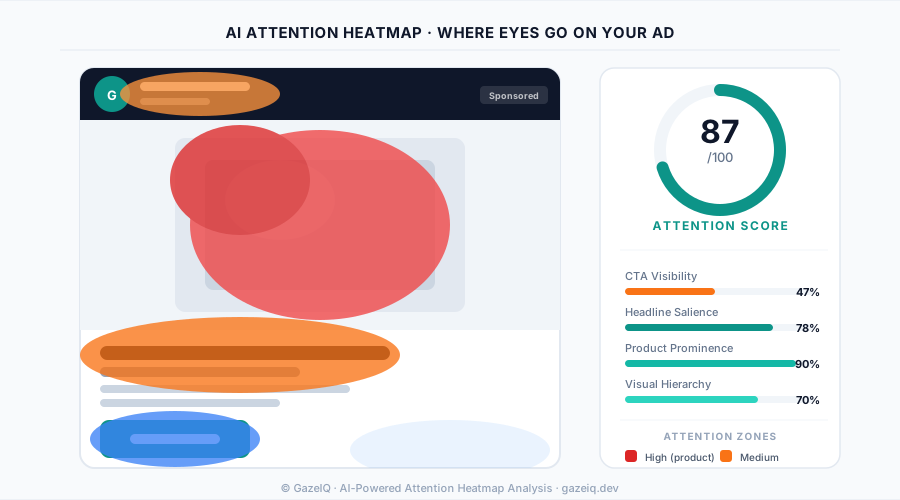
An attention heatmap is a color-coded visualization showing where human eyes are predicted to fixate on an image. The color scale typically runs from red (highest attention) through orange and yellow, down to green and blue (lowest attention).
In advertising, attention heatmaps answer a critical question: Are viewers actually seeing the elements that drive conversion? Specifically: Does your headline get seen? Is your product prominent? Is your CTA button in a zone where eyes land?
If your CTA is in a blue zone (low attention), viewers physically do not register it—regardless of how compelling the copy is. Fixing this before launch is the fastest lever to improve CTR without changing your targeting, budget, or offer.
How AI Generates Attention Predictions
Traditional eye-tracking requires physically positioning participants in front of a screen with specialized cameras that track pupil movement. It's accurate but expensive, slow (1–2 weeks per study), and impractical for testing every creative before launch.
AI attention models (also called saliency models) replicate this process computationally. They are trained on datasets of hundreds of thousands of images paired with real human eye-tracking recordings, learning the visual features that reliably attract gaze: faces, high contrast, motion, text, and structural prominence.
GazeIQ uses a deep saliency model (based on the TranSalNet architecture) that generates pixel-level attention predictions with 0.91 correlation to lab eye-tracking data. The result: heatmaps indistinguishable from expensive studies, delivered in under 8 seconds.
How to Read an Attention Heatmap
Primary fixation areas. Viewers' eyes spend the most time here. Any conversion element (product, headline, CTA) in a red zone is almost certain to be seen.
High-attention areas. Strong attention, slightly less fixation density than red. Good placement for CTAs and key copy.
Moderate attention. Elements here are noticed but not dwelt on. Suitable for secondary information like supporting copy or trust signals.
Low attention areas. Viewers rarely fixate here. Any element in a cool zone is at high risk of being missed entirely. CTAs in blue zones consistently underperform.
The Attention Score: One Number to Predict Ad Performance
GazeIQ converts heatmap data into a composite Attention Score from 0–100. The score weights four sub-dimensions:
CTA Visibility
Is the call-to-action in a high-attention zone?
Headline Salience
Is the primary text legible and in a fixation zone?
Product Prominence
Is the product the dominant visual element?
Visual Hierarchy
Does the layout guide eyes toward conversion elements?
Scores above 75/100 consistently correlate with above-average CTR performance. Scores below 60 indicate significant fixable issues in at least one dimension.
Attention Heatmaps vs. Traditional A/B Testing
| Dimension | Traditional A/B Test | AI Attention Pre-Test |
|---|---|---|
| Time to result | 1–2 weeks | < 8 seconds |
| Budget required | Live media spend on losers | $0 before launch |
| Sample size | Real audience (statistical noise) | AI model (consistent) |
| Actionability | Which variant won | Why it won + what to fix |
| Variants testable | 2–4 (budget constrained) | Up to 5 simultaneously |
Frequently Asked Questions
What is an attention heatmap?
An attention heatmap is a visual overlay that shows where human eyes are predicted to fixate on an image. Hot zones (red/orange) indicate areas of high attention; cool zones (blue/green) indicate areas that viewers typically ignore. In advertising, heatmaps reveal whether your CTA, headline, and product are being seen.
How accurate are AI attention heatmaps?
GazeIQ's attention models achieve a 0.91 correlation with laboratory eye-tracking data. This means the AI prediction of where viewers look closely matches where real human eyes actually fixate in controlled studies.
How is an AI heatmap different from a traditional eye-tracking study?
Traditional eye-tracking requires a panel of human participants, specialized hardware, and 1–2 weeks of study time—typically costing $5,000–$20,000 per test. AI heatmaps generate the same class of attention data in under 8 seconds, for a fraction of the cost, by using neural network models trained on millions of real eye-tracking data points.
What does a red zone on an attention heatmap mean?
A red zone indicates a high-attention area—a region where viewers' eyes are predicted to fixate most. For an ad, you want your most important conversion elements (CTA, headline, product) in red or orange zones.
What is a 'fixation sequence' and why does it matter for ads?
A fixation sequence is the ordered path that eyes travel across an image. The first 2–3 fixation points in a sequence are the most important for ads—elements outside those first fixation zones are often never processed at all. Understanding the fixation sequence helps you place your key message where it will be seen first.
Related articles