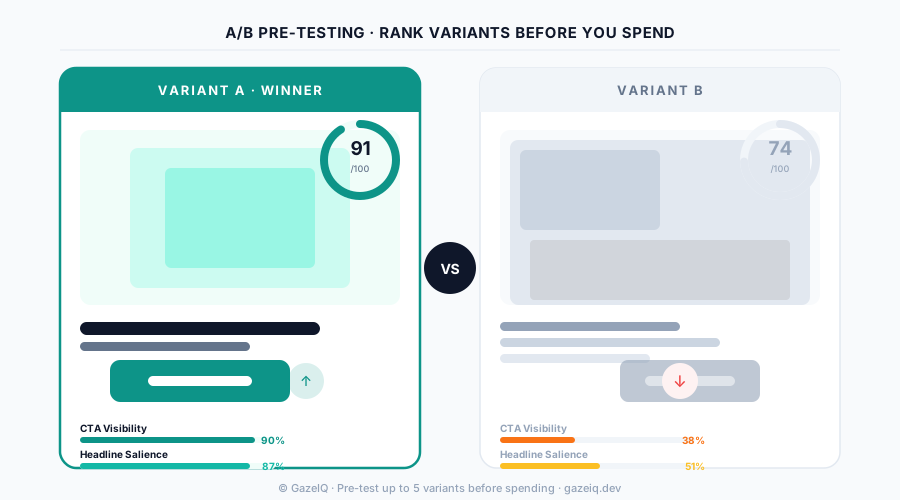
The Problem with Traditional A/B Testing
A/B testing is the gold standard of marketing experimentation. Run two variants simultaneously, collect real performance data, and promote the winner. The logic is sound—but the economics are painful.
To reach statistical significance, you need enough impressions for each variant. At typical social ad CPMs and CTRs, that means spending hundreds or thousands of dollars on the losing variant before you know it's a loser. Multiply this across every campaign, and you're consistently burning 30–50% of your creative testing budget on variants you could have eliminated before launch.
The real cost of A/B testing
If you're spending $5,000/month on a campaign and run a proper 2-variant A/B test, approximately $2,500 is allocated to the losing variant while you wait for significance. At scale, this adds up to tens of thousands in wasted creative testing spend annually.
What Is Creative Pre-Testing?
Creative pre-testing uses AI attention models to predict how an ad will perform—before it goes live. Instead of spending to find the winner, you rank variants by their predicted attention performance: CTA visibility, headline salience, product prominence, and visual hierarchy.
The variant with the highest predicted attention score gets the full budget from day one. Losers are eliminated before they cost you anything. When combined with a subsequent live test of the refined top performer, you dramatically reduce wasted spend.
Head-to-Head: A/B Testing vs. Pre-Testing
| Factor | A/B Testing | Pre-Testing (GazeIQ) |
|---|---|---|
| Time to result | 1–2 weeks | Under 2 minutes |
| Cost | Real media spend on losers | Scan cost only |
| Data type | Real click/conversion data | Predicted attention data |
| Variants at once | 2–4 (budget constrained) | Up to 5 simultaneously |
| Actionable insights | Which variant won | Why + specific fixes |
| Creative iteration | Sequential (slow) | Instant feedback loop |
| Statistical validity | High (real data) | High (0.91 lab correlation) |
| Best for | Validating final winners | Filtering losers pre-spend |
The Optimal Creative Testing Strategy
The answer isn't "A/B testing OR pre-testing"—it's both, in the right sequence:
Phase 1: Generate
Create 3–5 creative variants based on your hypothesis (different headlines, CTA placement, product angles).
Phase 2: Pre-test with AI
Upload all variants to GazeIQ. Get attention scores, heatmaps, and radar chart comparisons. Eliminate any variant scoring below 70/100.
Phase 3: Apply recommendations
For surviving variants, apply AI recommendations to improve CTA visibility and headline salience. Re-test the improved versions.
Phase 4: Launch top scorer
Promote the highest-scoring variant with full budget. You've already eliminated all likely losers without spending a dollar.
Phase 5: Live A/B test (optional)
If budget allows, run a live test between your top 2 pre-tested variants to capture real-world validation data for future creative briefs.
When to Use Each Method
Use A/B testing when...
- ·You have high monthly ad spend (>$10k/month)
- ·You need statistically significant conversion data
- ·Testing different offers or audience messaging
- ·Validating a pre-tested winner against a control
- ·Your creative quality is already high (scores 75+)
Use pre-testing when...
- ·You're launching a new creative or campaign
- ·Testing multiple visual variants (layout, CTA, product angle)
- ·Budget is limited and losing variants cost too much
- ·You need fast iteration (same-day creative feedback)
- ·Your team ships 5+ new creatives per week
Real Results: From 2 Weeks to 2 Minutes
Teams using GazeIQ for creative pre-testing report compressing their creative review cycle from 2 weeks (live A/B test) to 2 minutes (attention pre-test). One performance marketing lead put it this way:
"GazeIQ cut our creative testing cycle from 2 weeks to 2 minutes. We now pre-test every ad before it goes live—and our average CTR has increased 34% since we started."
The math is simple: if pre-testing identifies and eliminates even one losing variant per campaign, it pays for itself many times over at any meaningful media spend level.
Related articles