The Problem with Post-Launch Learning
Traditional ad creative analysis happens after launch. You run the campaign, collect CTR and conversion data, identify the winner, and pause the losers. The problem: by the time you have statistically significant data, you've already spent on the underperformers.
AI ad performance prediction inverts this. Instead of running ads to find out if they'll work, you analyze the creative before launch—identifying attention problems, CTA placement issues, and headline contrast failures before they cost you budget.
Post-launch learning (traditional)
- → Launch all variants
- → Wait 1–2 weeks for data
- → Identify winner from live spend
- → Losers cost real budget to find
- → No diagnosis for why it lost
AI pre-launch prediction
- → Upload creative variants
- → Get scores in under 8 seconds
- → Fix identified problems pre-launch
- → Launch only validated creatives
- → Know exactly why each element scored
How AI Predicts Ad Performance
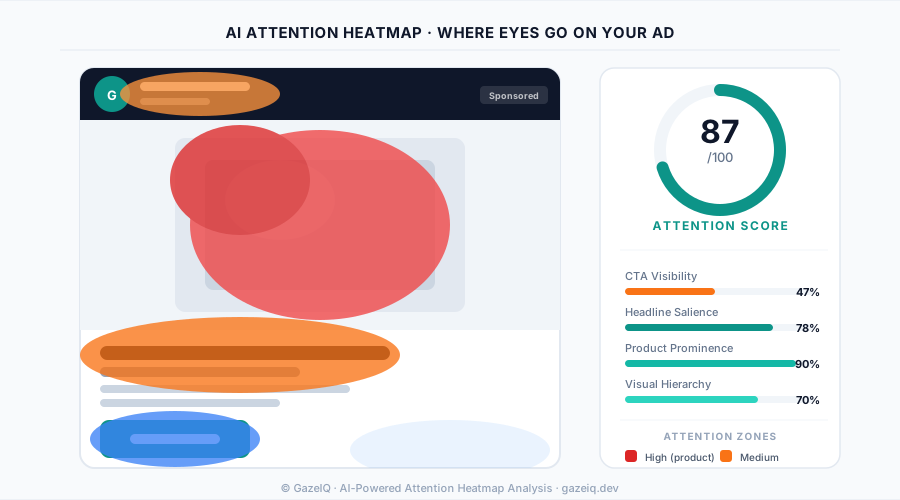
AI ad performance prediction is built on a specific chain of logic: if we can accurately predict where viewers will look, we can score whether the most important creative elements (CTA, headline, product) are in those zones—and those scores correlate with live CTR performance.
Visual saliency modeling
The model computes which pixels in the image are most likely to attract spontaneous attention, based on contrast, color uniqueness, edges, faces, and text density. This produces a continuous attention probability map across the entire creative.
Gaze path simulation
A fixation sequence model converts the saliency map into a realistic gaze trajectory—the order in which a viewer's eye is likely to move across the creative during the first 2–3 seconds. This models the actual viewing behavior, not just raw salience.
Element detection and scoring
Key creative elements (CTA button, headline text, product image, brand logo) are detected in the image. Each is scored based on how much of its area falls within high-salience zones in the fixation path—producing a 0–100 visibility score for each element.
Recommendation generation
Elements scoring below threshold trigger specific fix recommendations. These aren't generic suggestions—they're targeted: 'Your CTA is in the bottom 30% of predicted gaze coverage. Moving it to the upper-center zone would increase its visibility score from 54 to 78+.'
Composite scoring
A weighted composite of element scores, gaze path coverage, and visual hierarchy quality produces the overall attention score. This is the single number that most reliably predicts live performance: creatives scoring ≥ 75 consistently outperform those scoring ≤ 60.
Understanding Your Performance Score
GazeIQ returns four scores for every creative. Here's what each measures and how to interpret it:
Overall attention score
0–100Composite quality of the creative's attention architecture
CTA visibility score
0–100Whether the CTA intersects the predicted gaze path
Headline salience score
0–100Contrast and position of the primary headline element
Product prominence score
0–100Visual dominance of the product or hero image
Score Ranges and What to Do with Them
Excellent attention architecture. CTA and headline are in high-attention zones. Launch with full budget and consider scaling.
Good creative with strong fundamentals. Minor improvements possible but not required before launch. Monitor live performance.
One or more elements are underperforming. Apply the specific AI recommendation for the lowest-scoring element. Re-score before launching.
Multiple attention problems. The creative will likely underperform. Apply all recommendations and re-score. Consider a different creative direction if score doesn't improve.
The creative has fundamental structural problems that can't be fixed with small edits. Start a new design iteration using the AI recommendations as a brief.
What AI Prediction Can and Can't Tell You
AI performance prediction is a powerful pre-launch filter—but it has clear limits. Understanding both sides helps you use it correctly:
What AI scoring predicts well
- ✓CTA visibility and clickability
- ✓Headline legibility and salience
- ✓Visual hierarchy quality
- ✓Platform-specific attention fit
- ✓Whether the creative passes the 1.5s test
What AI scoring can't predict
- →Whether the offer resonates with your audience
- →Audience-specific emotional response
- →Brand recognition effects for existing customers
- →Actual conversion rate (post-click behavior)
- →Offer-market fit
AI scoring is a pre-launch attention filter, not a complete campaign predictor. A creative can score 85 on attention and still underperform if the offer isn't right for the audience. Use it to eliminate creative problems—then validate with live data.
Frequently Asked Questions
Can AI predict ad performance before launch?
Yes. AI attention models can forecast which elements will capture viewer attention, whether the CTA is in a high-fixation zone, and whether the headline has sufficient visual salience. GazeIQ returns attention scores and gaze path predictions in under 8 seconds. These pre-launch scores correlate strongly with live CTR performance.
What does an ad performance prediction score measure?
GazeIQ's scores measure: (1) Overall attention score (composite attention architecture quality). (2) CTA visibility score. (3) Headline salience score. (4) Product prominence score. Creatives scoring above 75 overall consistently outperform those scoring below 65 in live campaigns.
How does AI ad creative analysis work?
AI ad creative analysis uses deep learning models trained on millions of eye-tracking recordings to predict where viewers will look on any ad image. The model computes a saliency map, simulates a fixation path, scores each key element against that path, and generates specific fix recommendations for low-scoring elements—all in under 8 seconds.