Why Most Ads Don't Convert
Most underperforming ads aren't failing because of bad offers. They're failing because the offer never gets seen.
The average viewer spends 1.7 seconds looking at a social media ad before deciding to scroll or click. In that window, their visual system is making fast, largely automatic decisions about where to look and what to process. If your CTA is in a dead zone—an area outside the viewer's natural gaze path—most viewers will never register it, no matter how compelling the copy.
Building high-converting ads starts with understanding where attention goes—and engineering your creative to put your most important elements there.
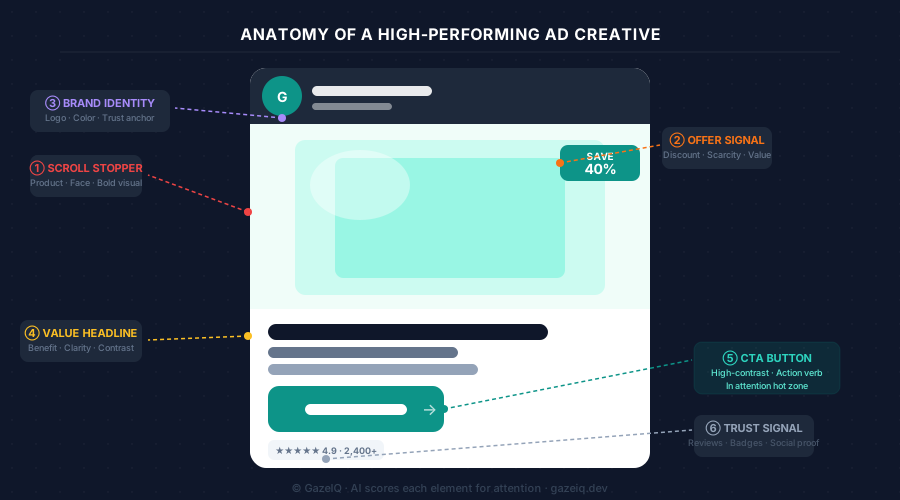
The 5 Elements Every High-Converting Ad Must Get Right
The scroll stopper
The first 1.5 seconds determine whether a viewer pauses or scrolls. Your creative needs a visual or emotional hook that breaks the pattern of the surrounding content. This can be contrast (bright vs. muted), motion (for video), a provocative image, or an immediately legible offer ('50% off — today only').
The offer signal
Within the first 2 seconds, viewers should understand what the ad is offering. Not the features—the outcome. '3x your ROAS' beats '14 advanced AI features.' The offer must be visible without requiring additional cognitive effort: no squinting, no reading dense copy.
The CTA in a high-attention zone
Your call-to-action must physically intersect the viewer's natural gaze path. Eye-tracking data shows that most viewers scan social ads in a Z-pattern or F-pattern. If your CTA sits below the fold or in the periphery of this path, the majority of viewers will never register it—regardless of how compelling the copy is.
A single dominant element
High-converting ads have clear visual hierarchy: one element commands attention, everything else supports it. When a background pattern, logo, product, lifestyle image, and headline all compete for primacy, none wins. The viewer's brain resolves the conflict by disengaging—and the scroll continues.
Mobile-first legibility
80%+ of Facebook and Instagram impressions occur on mobile. Any text in your ad must be legible at 375px viewport width. Minimum viable font sizes: 18–20px for headlines, 14px for body copy, 12px for secondary information. Test your creative on a physical phone before launch—a design that looks great on a 27-inch monitor often fails on a 6-inch screen.
The Attention-First Creative Process
High-converting ad teams build attention architecture into their creative process—not as a post-production checklist, but as a design constraint from the start.
Brief stage
Define which element must be dominant before design starts. Not 'the ad should feel premium'—'the CTA must be the most visually prominent element after the product.'
First draft
Apply the single-dominant-element rule immediately. If the designer has added three competing focal points, simplify before moving forward.
Review stage
Test the 1.5-second comprehension test on every stakeholder review: what does this ad communicate in 1.5 seconds? If reviewers can't answer consistently, the creative fails the test.
Pre-launch scoring
Upload the final creative to GazeIQ. Verify CTA visibility ≥ 75, headline salience ≥ 70, and overall attention score ≥ 65 before launch. If any score is below threshold, apply the specific recommendation and re-score.
Post-launch iteration
Use live CTR data to validate or challenge the pre-test predictions. Feed discrepancies back into your creative brief—and use them to calibrate your team's intuitions over time.
Platform-Specific Creative Best Practices
Facebook Feed (1:1)
- →CTA must be in the top two-thirds of the creative
- →Text overlay kept under 20% of the image area
- →High-contrast, legible headline at 375px viewport
- →Product shown in the first 150px of the creative
Instagram Stories (9:16)
- →All key elements inside the safe zone (15% top and bottom buffer)
- →Brand logo top-left, CTA in the lower third
- →Motion in the first frame increases stop rate by 30–50%
- →Maximum 6 words of visible text overlay for legibility
Google Display (multiple sizes)
- →Strong contrast between background and all text elements
- →CTA button visible as a distinct interactive element
- →Brand logo always present—display ads have lower recall without it
- →Test all size variants before launch—attention patterns differ
Frequently Asked Questions
What makes an ad high converting?
High-converting ads share five characteristics: (1) A scroll stopper within 1.5 seconds. (2) A CTA in a high-attention zone. (3) A high-contrast headline communicating the core offer. (4) A single dominant visual element. (5) Mobile-first optimization with legible text at 375px width.
What is a good conversion rate for ads?
For e-commerce, a 2–5% landing page conversion rate from ad traffic is solid. For lead generation, 5–15% lead capture from ad clicks is typical. At the ad level, CTR above 1.5% on Facebook Feed is strong, and above 0.6% on Google Display is above average.
How do I know if my ad creative will convert before I launch?
AI pre-testing tools like GazeIQ can predict ad performance before launch. Upload your creative and receive an attention heatmap, element-level scores for your CTA, headline, and product, plus specific AI recommendations. Creatives scoring above 75 on GazeIQ's attention score consistently outperform lower-scoring variants in live campaigns.