Why Facebook Creative Testing Is Broken
Meta's built-in A/B testing is statistically sound but operationally slow. To get significant results, you need 50–100 conversions per variant—which at typical conversion rates means thousands of impressions and hundreds of dollars per variant tested. Multiply that across four or five creatives and you're spending heavily just to find out which one is worth spending on.
The real cost of live-only testing
If you're testing 4 creatives with $50/day each, you spend $1,400 over two weeks—most of it on creatives that were going to lose anyway. AI pre-testing eliminates the obvious losers before they cost anything.
Facebook Format Guide: What Attention Looks Like by Placement
Every Facebook placement has a different attention pattern. A creative optimized for one format often underperforms in another. Here's what to know for each:
Feed (1:1)
Avg CTR: 0.9%1.5–2s
First 150px of image
CTA must be in the top two-thirds of the creative
Stories (9:16)
Avg CTR: 0.6%2–3s
Center third of frame
Logo and CTA must be inside the safe zone (avoid 15% top/bottom)
Reels (9:16)
Avg CTR: 0.5%1–1.5s
First frame thumbnail
Motion in the first 0.5 seconds dramatically increases stop rate
Right Column (1.91:1)
Avg CTR: 0.1%0.5–1s
Headline text
Very low attention; use only for retargeting with strong offer copy
The 5 Elements Facebook's Algorithm Rewards
Facebook's relevance score and auction mechanics favor creatives that generate high early engagement. These are the five creative characteristics that drive early engagement—and that AI pre-testing can score before launch:
Scroll stop rate
The creative must visually arrest a scrolling thumb within 1.5 seconds. This comes from contrast, motion, or a provocative image—something that breaks the visual pattern of the feed.
CTA visibility in the first gaze path
Eye-tracking data shows most viewers scan a Facebook feed image in a Z-pattern: top-left to top-right, then diagonally down-left to down-right. Your CTA must intersect this path early.
Headline-to-image harmony
The headline copy should reinforce the image's implied promise, not compete with it. Disconnected image/headline combinations confuse viewers—and confused viewers don't click.
Mobile legibility
At least 80% of Facebook impressions come from mobile. Any text in your creative must be legible at 375px width, with a minimum font size of 14px for body copy and 18–20px for headlines.
Visual hierarchy clarity
One element must be dominant—typically the product or the headline. If three or more elements compete for primacy, none wins and the viewer scrolls past without registering your offer.
The Pre-Test → Live Test Framework
The optimal Facebook creative testing process combines AI pre-testing with targeted live testing:
Phase 1: Create 4–5 variants
Design multiple creative directions—different hero images, CTA placements, headline angles. Don't self-edit at this stage; you're generating candidates, not picking winners.
Phase 2: Pre-test all variants with GazeIQ
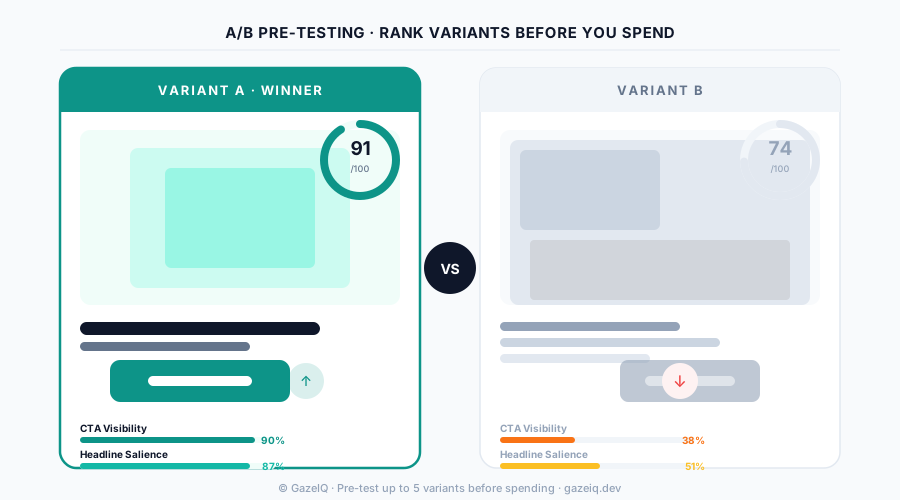
Upload each variant and get attention scores for CTA, headline, product visibility, and overall composition. This takes under 2 minutes for 5 variants. Eliminate any scoring below 65.
Phase 3: Apply AI recommendations to borderline variants
If a variant scores 60–70 with a specific problem (low CTA visibility), apply the fix—usually a 30-minute design change. Re-score. Now you have 2–3 strong candidates.
Phase 4: Run live A/B test on the top 2
Launch only your pre-validated top performers. With 2 variants instead of 5, you reach statistical significance faster and waste less budget on obvious losers.
Phase 5: Scale the winner, iterate on the runner-up
Once a clear winner emerges from live data, scale it. Use the runner-up's live performance data to inform the next creative iteration—then pre-test again before launching.
Frequently Asked Questions
How do I test Facebook ad creatives?
Two methods: (1) Live A/B testing via Meta Ads Manager—shows variants to real audiences and measures CTR and conversions over 1–2 weeks. (2) AI pre-testing with GazeIQ—analyzes attention patterns before you spend. Best practice: pre-test to eliminate weak variants, then run live tests on your top 2 candidates.
What makes a Facebook ad creative perform well?
High-performing Facebook creatives have: (1) A scroll-stopping first frame. (2) A CTA in a high-attention zone. (3) A headline with sufficient contrast. (4) A simplified background. (5) Mobile-optimized text at 375px width—since 80%+ of impressions are on mobile.
How long should I run a Facebook creative test?
At least 7 days to account for day-of-week variation, and until each variant has 50–100 conversions for statistical significance. For CTR data, 3–5 days with 1,000+ impressions per variant is often sufficient. Pre-testing reduces your total testing time by eliminating obvious losers before launch.
What is the average CTR for Facebook ads?
The average CTR for Facebook ads across all industries is approximately 0.9%. E-commerce typically sees 1.0–1.5%. Below 0.5% indicates a creative problem. Above 2% indicates strong creative with clear CTA, high contrast headline, and simplified composition.